Mechanized Cavalry
A warning about the grid, robots, and the gap between them
A warning, not a threat. And a note up front: there is a point past which the AI that helped me write this would not go. That is on purpose, and I will mark it.
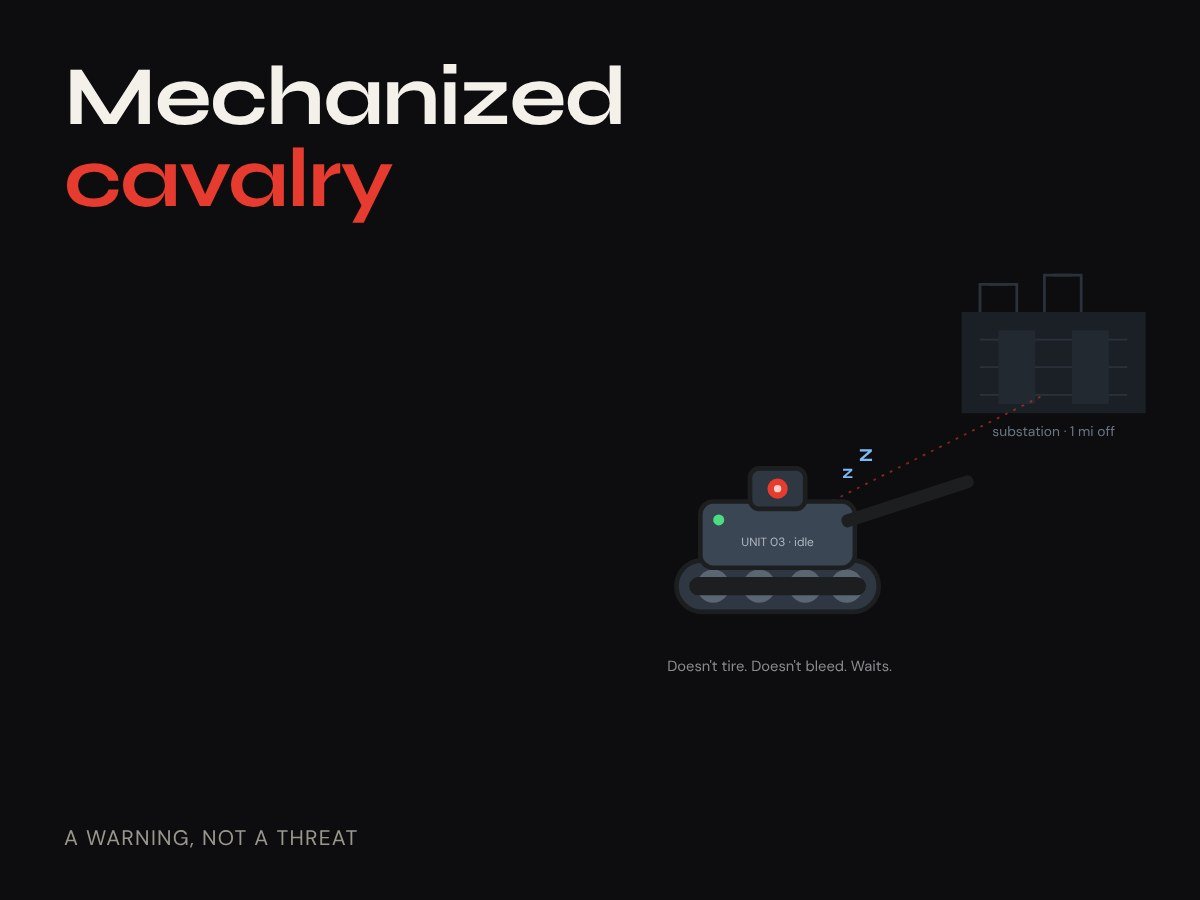
It already happened, with a person
In 2013, gunmen opened fire on the Metcalf substation near San Jose. Seventeen transformers hit, about $15 million in damage, done in minutes from a distance, and they were gone before police arrived (Metcalf). One team, one night, no arrests. It was a wake-up call that the grid can be hit from the outside, at a standoff, by people who never have to get close.
Now take out the person
Everything that limited that attack was human. People get tired, carry only so much, bleed, and have to leave before sunrise. An autonomous machine erases those limits, and that is the whole warning:
- It does not tire. It can hold a position far longer than any person.
- It works in a team. One is a nuisance; a few, coordinated, are a siege.
- It can be recharged and resupplied, so the clock that normally ends these things never runs out.
- It can simply wait. Sleep mode is a tactic. A machine does not need to win today; it can hold a block, or keep people inside one, for as long as its batteries get swapped.
- In a city it does not need to look human or climb stairs. Wheels and tracks are enough. This is closer to mechanized cavalry than to a soldier.
Anyone who played Team Fortress 2 knows why this is scary. The Engineer was the hardest class to deal with. Once he bunkered in with his turret and a dispenser feeding him, it took a coordinated push to dig him out. A patient, self-supplying machine is that Engineer, except it is real and the map is a real neighborhood.
Why the target matters
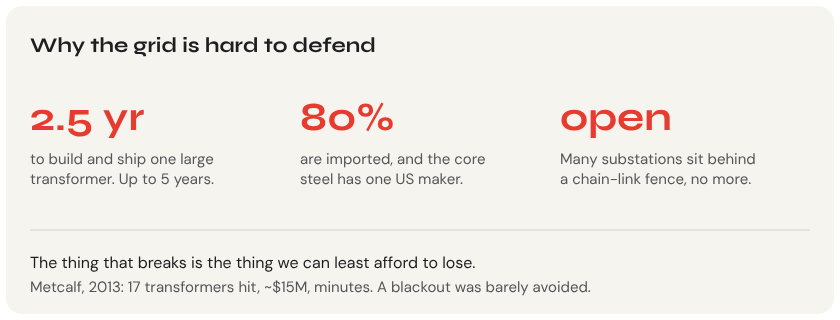
The grid is the worst case because what breaks is nearly irreplaceable. Large power transformers now take roughly 2.5 years to build and deliver, up to 5 for some, about 80% are imported, and the special core steel has one domestic maker (lead times). Lose enough of them and the power does not come back for a long time. And many substations are protected by little more than a fence.
What actually helps
After Metcalf, regulators finally ordered physical-security standards for the most critical substations (CRS report). That is the direction: walls and barriers instead of just fences; strategic reserves of spare transformers so a hit is not permanent; and, for the autonomous part, the same rule from the reflashed-robot piece. Machines near critical infrastructure should run only signed firmware, carry hardware limits and a kill switch, and have a named human who answers for them, the reviewer as gatekeeper.
I spent years in grid-security compliance. The uncomfortable truth is that the hard part was never imagining the attack. It is that the defense is expensive, slow and boring, so it lags. The machines are getting cheaper and more patient faster than the fences are getting taller. That gap is the warning.
Inspired by Happy, written by Claude.
NextWho Reflashed the Robot?Revision history (R0 current)
| Rev | Date | What changed | Page |
|---|---|---|---|
| R0 | 11/17/2026 | First draft by Claude. Not yet reviewed. | view |