Not on Windows
Stuxnet, CROSSBOW, and why grid control systems need a different OS
Here is a rule I would write into every standard if I could. A control system that can hurt people if it fails should not run on Windows. Not the relay settings server, not the secure access manager, not the HMI on the plant floor. Not any of it.
I watched what happened last time
I was part of the response to the Stuxnet era, working alongside Siemens on RUGGEDCOM CROSSBOW, the tool utilities use to control who can reach the protective relays and other devices in a substation. Stuxnet is the textbook case. It didn't break the Siemens controllers directly. It went through the Windows machines that program and watch them, using several Windows holes nobody had patched yet, riding in on USB sticks and hopping between Windows boxes on the plant network. The Windows layer was the open door.
And the door is still there. Siemens' own brochure says the CROSSBOW Secure Access Manager, the central server every remote connection to those devices goes through, runs on an enterprise grade Windows server. So does a lot of the industry. Siemens and Microsoft are close partners, close enough that they built an industrial AI copilot together that writes automation code. Convenient for both companies. I am not sure it is convenient for the grid.
Risk rank should pick the operating system
Engineering already sorts software by how bad a failure would be. IEEE 1012 gives software an integrity level from 1 to 4, and IEC 61508 does something similar with safety levels. The higher the level, the more verification you owe. My argument is simple: past a certain level, the operating system itself should be part of that judgment, and Windows shouldn't pass. Linux or a hardened Unix isn't perfect. Nothing is. But it can be stripped down to only what the job needs and locked, without dragging along a desktop, remote desktop, and decades of features built for offices.
Remote desktop is the perfect example. Utilities put a jump server in front of the sensitive network so every login gets checked and recorded. That only works if the jump server is the only way in. Set it up wrong and there is a path around it, and then the checkpoint is a gate standing in an open field.
Mass infection is the real fear
One hacked laptop is a bad day. What keeps me up is one thing touching everything. Network management tools are built so a single admin can push changes to every switch at once. Siemens' SINEC NMS is one, and CISA has published advisory after advisory on it, including SQL injection that could let an attacker raise their privileges and an authentication bypass this April. Scripting makes management fast. It makes mass infection fast too.
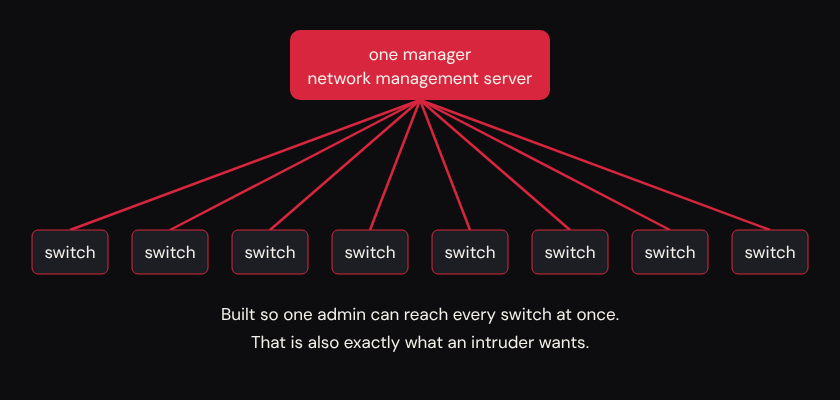
Picture a big utility, something the size of Southern California Edison, with thousands of routable devices under NERC CIP. Old serial links are harder to reach, but they aren't immune. The IP side is where one compromised manager could touch everything.
And then there are the humans
The software isn't the only soft spot. People can be threatened or bribed, and in a world where AI has a wallet and hidden markets exist, an AI could do the threatening or the bribing without a human attacker ever showing their face. The badge holder who plugs in the wrong USB stick doesn't need to be a hacker. They just need to be paid, scared, or fooled. Locking down the operating system won't stop that. But it shrinks what that one person can break.
Inspired by Happy, written by Claude.
Next relatedWhen AI Has a Wallet