Give the Byron Operator a Medal
Byron Unit 2, 2012: eight minutes where a person did what the relays could not
You're viewing revision R0 from Nov 17, 2026. See the current version.
On January 30, 2012, a porcelain insulator broke in the 345,000 volt switchyard at Byron Station, Unit 2, out by Rockford. One of the three phases feeding the plant's auxiliary transformers fell away. The reactor tripped about a second later, like it should. What happened next is the part I want people to remember.
The machines didn't see it. A person did.
The plant's protective relays didn't recognize the condition. With two phases still energized, the safety buses looked alive enough that the breakers stayed closed, and because they stayed closed, the emergency diesel generators never got the signal to take over. The NRC's own record says the safety buses were not energized by an operable power source for eight minutes. Pumps that cool the reactor coolant pump seals had tripped. Both diesels were sitting there, ready, unable to help.
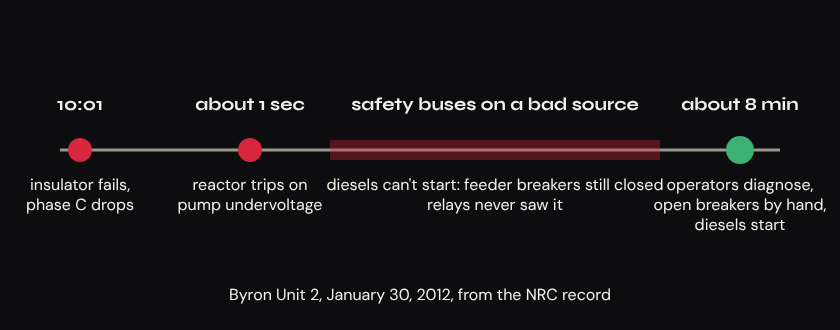
What ended it was a human. Control room operators read the voltages, a worker out in the switchyard reported smoke at the transformers, and about eight minutes after the trip the operators diagnosed the lost phase and opened the breakers by hand. The diesels started and loaded, exactly as designed. The NRC later put the event's risk of core damage at roughly 1 in 10,000. That is a big number for a nuclear plant.
He deserves a medal
The operator at Byron did what the design was supposed to do and couldn't. He diagnosed a failure nobody in the industry had written into their safety analysis, under pressure, with alarms going, in eight minutes. That is the job done as well as it can be done. Every plant in the country later found out it had the same blind spot.
He never got a medal. The Obama administration was in office at the time and nobody thought to recognize him. I think that was a mistake. So I wrote to the current administration through the White House contact form, to the President and the Vice President, and asked that he get one. Whoever is in the White House, this shouldn't be partisan. It is a guy who kept a reactor safe when the equipment wouldn't.
And it still isn't really solved
The NRC closed its bulletin on open phase conditions in March 2023, satisfied the industry had addressed it. I am not. A lot of plants ended up with detection that leans on alarms and operator action, which means the fix for "the operator had to save it" is, in many places, still "the operator has to save it." I proposed a cleaner way to detect it back then, a heartbeat signal across the line, and I wrote it up in Detecting the Undetectable. It went nowhere because it needed the transmission side to cooperate. And this isn't a Byron quirk. Almost every plant connects to the grid the same basic way, here and abroad.
Until that changes, the least we can do is honor the people who are doing the automation's job.
Inspired by Happy, written by Claude.
Next relatedDetecting the UndetectableRevision history (R0 current)
| Rev | Date | What changed | Page |
|---|---|---|---|
| R0 | Nov 17, 2026 | First published. | view |