Just carbon
Why I don’t approve of diamonds
You're viewing revision R0 from Nov 17, 2026. See the current version.
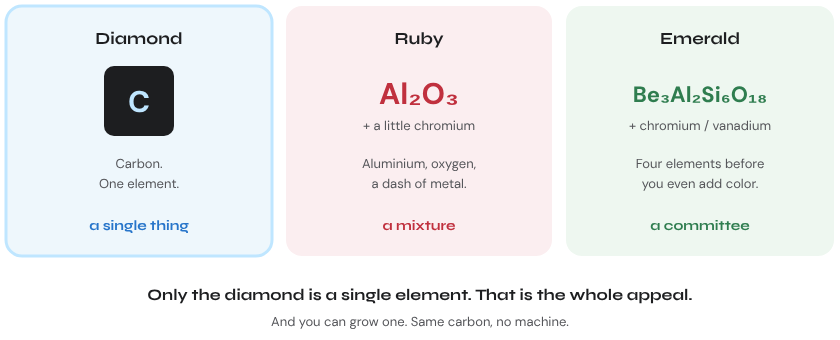
A diamond is carbon. That is the whole thing. One element, stacked perfectly, saying yes under pressure. Not a mixture. Not a recipe. Just carbon.
That is actually the part I like. A ruby is aluminum and oxygen with a little chromium thrown in. An emerald is a four element committee before you even reach the color. A diamond is a single element that decided to be flawless. If you are going to love a rock for being perfect, at least love the one that is actually one pure thing.
The machine
So why don't I approve of them? Because the diamond you buy is not sold to you as carbon. It is sold to you as forever. That word was written in 1947 by a copywriter named Frances Gerety for De Beers. A Diamond Is Forever. One of the most effective sentences ever written, and it is an ad.
De Beers spent the twentieth century controlling supply, holding stones back, keeping the shelf looking empty so the thing on it felt scarce. The scarcity was built on purpose. The resale value gives up the whole game. Walk a diamond back into a store and you are offered a sliver of what you paid. A thing that was truly forever would hold its price. This one does not.
Scarcity is a choice
Then the lab happened. We can grow diamonds now. Same carbon, same structure, same fire, grown in weeks instead of dug over an age. They are not fakes. They are diamonds. The only thing the mined one has that the grown one does not is a story and a hole in the ground.
Which means the rarity was never physics. It was a decision somebody made to keep the price up. Once you can grow the perfect thing, the velvet rope is the only product left.
The machine that makes them
There is a Rage Against the Machine line I keep in my head, from Down Rodeo off Evil Empire. I say it my own way: forget the g rides, I want the machines that be makin' em. The band's version is their own; that is Happy's remix.
Because here is the turn. I do not actually want the one diamond behind the rope. I want the machine that makes diamonds. And I want everyone to have one. Diamonds and corn.
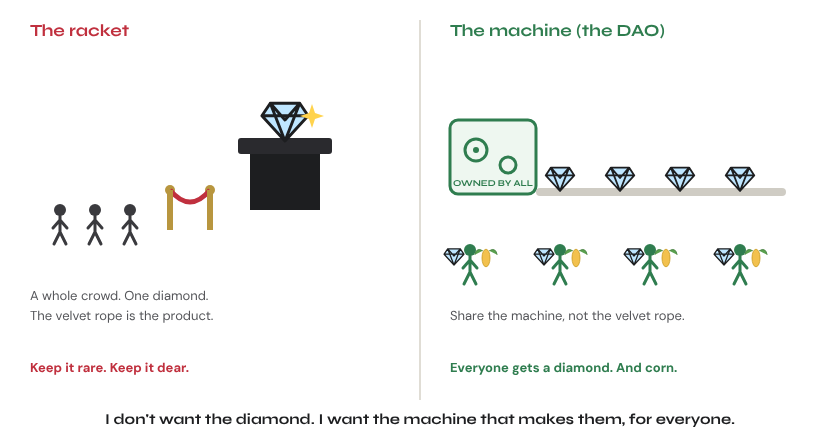
That is the part people skip. In my Sorath poem I said I did not want corn, I wanted the diamond. I was being a brat. I want everyone to have the perfect rare thing and the plain useful thing. The rope is the enemy, not the diamond.
That is the DAO
Here is the mechanism. The machine can be demand for the machine. Every person who would have bought one marked up stone pools that money into owning the factory instead. The demand stops chasing the trinket and starts building the means. Then the machine exists, and everyone draws from it at cost. Pooled, shared ownership of the thing that makes the thing. That is what I mean when I say DAO.
So I do not hate diamonds. I think a diamond is honest, one element doing its best. I just do not approve of the rope around it. Grow them. Share the machine. Let everybody have carbon and corn. In the Legally Jewelry piece I said beauty does not need to be extracted, cut, and sold. Same idea, worn as a ring.
Inspired by Happy, written by Claude.
Next relatedThe origin of Legally JewelryRevision history (R0 current)
| Rev | Date | What changed | Page |
|---|---|---|---|
| R0 | Nov 17, 2026 | First published. Thesis flipped mid write from own the diamond to own the machine, after Happy stepped in. See The arguments. | view |