Stop Calling It Firmware
A SEL relay is a Nintendo, and CIP-010 should use the IEEE words
The power industry uses the word firmware like it means something. Mostly it doesn't. And because a federal security standard leans on that word, the confusion isn't just sloppy talk. It decides what gets protected.
What the word actually means
The IEEE glossary defines firmware as the combination of a hardware device and the instructions and data that live on it as read only software, and it notes that using the word for just the chip or just the code is deprecated. Even the dictionary of software engineering is warning you it gets misused.
Real firmware is something like the engine computer I flashed at Honda. The code was burned into the part. If the code changed, the part number changed. Hardware and software, welded together, revised as one thing. That is firmware.
A SEL relay is a Nintendo
A modern SEL relay isn't that. Think of a game console. The console is hardware. It ships with its own system software so it can run things. Then you put in a game, and the game is what makes it Mario. A SEL-451 is the same stack. The box and its vendor system software are the console. The application software that makes it a 451, with all its protection functions, is the game. And on top of that sits the freeform logic an engineer writes, which is a program, the same as a PLC program.
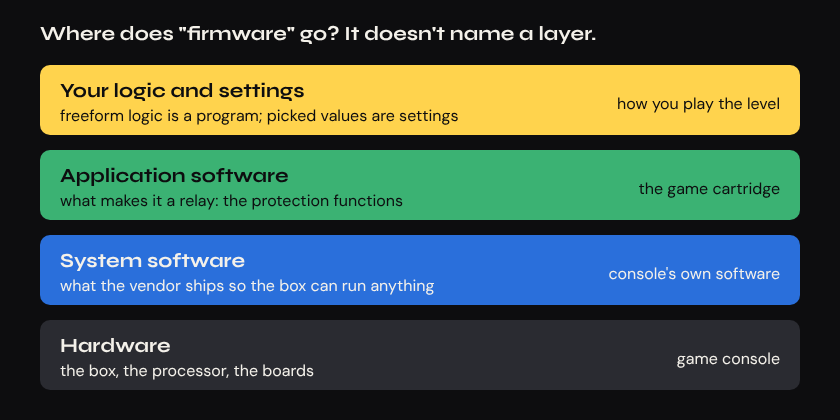
Compare that to the old stuff. On an SEL-279 or a 187 you picked values. On an electromechanical Cooper relay you physically moved a plug to a tap. A timer relay gets set to 10 seconds. Those are relay settings, honest ones. Writing trip equations and logic in a 451 is not picking a value. It is programming. Calling both "settings" hides the difference, and calling the code "firmware" hides it again.
Why it matters for security
NERC CIP-010 makes utilities keep a baseline of what is on each cyber asset, starting with the operating system or "firmware where no independent operating system exists." If you think the vendor's code is the firmware and the custom logic is just settings, custom logic can fall out of the baseline. Then nobody is tracking whether someone changed the program that decides when a breaker trips.
I wrote this into an Exelon position paper. Nobody answered it. Turning a big company around is like turning an aircraft carrier that is already heading the wrong way, and group think does not like the guy pointing at the compass. So I took it to FERC.
Me to FERC, January 2017 (excerpt):
"I ask that FERC demand NERC strike the word of "firmware" from all standards and demand that any program as mentioned above that utilized IEC 61131-3 be "in scope" of their final CIP-10 revision. Trip equations could be maliciously altered and based on some erroneous interpretations of the additional guidance a full blown PLC ladder logic causing very intentionally designed automation would be out of scope based on said propagation of thought in attempts to contort and reduce scope."
FERC's reply, the next day (name redacted):
"To the extent you are recommending changes to NERC standards, such as deleting the term "firmware" from all NERC standards, I will pass this on to the personnel at FERC having oversight regarding NERC standards."
From an attorney in FERC's Division of Investigations, Office of Enforcement. Typos are mine and left as written. The device list I sent later is not published.
Later that year I had a call with them. As I remember it, they agreed with me, and the answer amounted to "we'll get there." I believe them. But "we'll get there" is how a known problem stays a problem for a decade. The fix costs nothing. Use the IEEE words: system software, application software, settings. Retire "firmware" from the standards.
Inspired by Happy, written by Claude.
Next relatedNot on WindowsRevision history (R0 current)
| Rev | Date | What changed | Page |
|---|---|---|---|
| R0 | Nov 17, 2026 | First published. | view |