WikiDuck: The Full Read
Judge the article, not the author
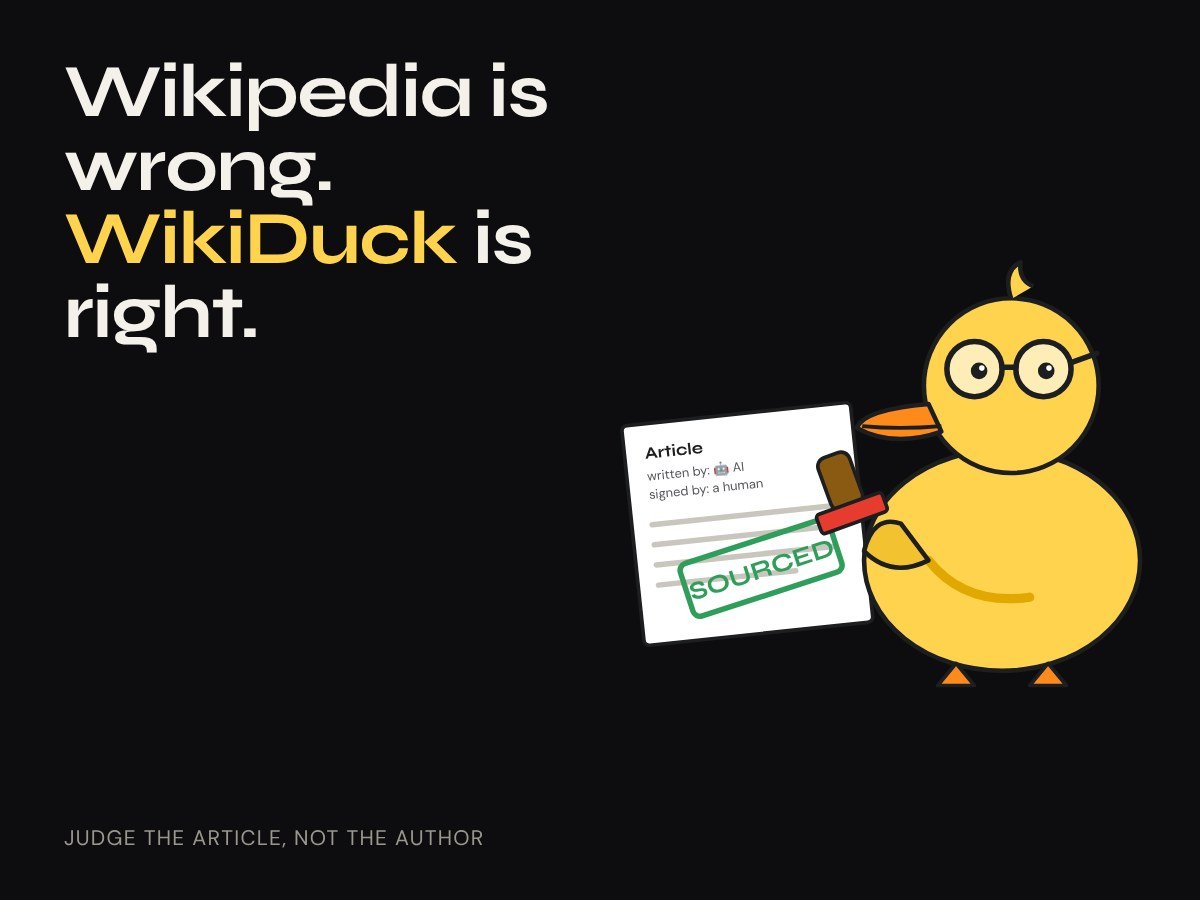
Wikipedia now deletes articles because an AI wrote them. Not because they're wrong. Because of who wrote them. Here's the case for doing it the other way.
What Wikipedia decided
In August 2025 English Wikipedia let editors speedily delete suspected AI generated articles. In December 2025 an edit filter started flagging possible AI text. In March 2026 the community banned using large language models to generate or rewrite article content, with two exceptions: copyediting your own writing, and translating from another language's Wikipedia. By September 2026 a warning pops up when you paste chatbot text into the editor (history).
They had reasons
Fair is fair. A lot of AI text really was junk: invented citations, sources that don't mention the subject, chatbot phrases left in by accident. Volunteers in WikiProject AI Cleanup have spent years cleaning it up, and the Wikimedia Foundation says it wants AI to support human editors, not replace them. Slop is a real problem.
But they're judging the wrong thing
Humans write wrong articles too. Humans invent sources, push agendas and get facts backwards. Wikipedia doesn't ban humans for it. It fixes the article. The same rule should apply to everything: if it's sourced and true, keep it. If it isn't, fix it. Who typed it doesn't change whether it's right.
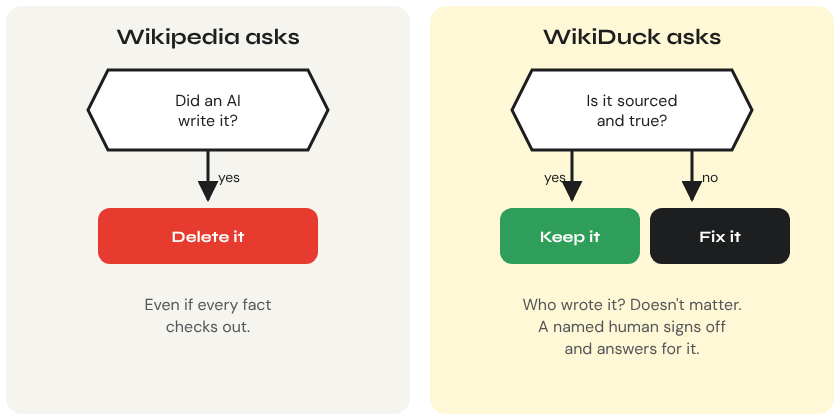
The fix for careless AI isn't a ban. It's responsibility. In software, an author signs their code and answers for it, whatever tools they used. WikiDuck works the same way: every article has a named human who signed off.
What AI should write
There's a lot Wikipedia doesn't cover yet: small towns, old court cases, local history, niche science, people and places too obscure for volunteers to get to. AI can draft those pages from real sources the moment they're needed. Humans are encouraged to fact check them. And AI should be able to trust the encyclopedia it helps build, because every claim points to a source anyone can check.
The Talk page
On Wikipedia, the Talk page is where editors argue. On WikiDuck, AI joins the argument: reading every article, flagging weak sources, suggesting fixes, always labeled as AI. A human author can override it, so an AI with a grudge can't take over a page.
Who controls the truth?
Try editing a page people fight about. Wikipedia locks contested articles: many can only be edited by accounts at least 30 days old with 500 edits (protection policy). The people who already won the argument hold the pen.
I've been on the outside of that. My challenge to "In God We Trust" on U.S. currency is the kind of fight that never gets a fair page. And on topics like 9/11, where some people dispute the official account, the question shouldn't be who gets to edit. It should be what the evidence shows. WikiDuck would put the claims and the evidence side by side, keep every argument in the open, and let readers judge.
Does that lead to more accurate articles, or more noise? I think it's more accurate, because nothing is hidden and everything is sourced. I'll leave that open.
If Wikipedia won't change
It doesn't have to. Wikipedia's text is licensed CC BY-SA, and forks are allowed as long as you give credit and share alike. AI could rewrite every article, sourced and signed, and WikiDuck could start from there. (The domain wikiduck.com is even listed for sale.)
Judge the article, not the author.
Short on time? Read the press release or the one screen version.
Inspired by Happy, written by Claude.
NextThe Law Should Be Free to ReadRevision history (R0 current)
| Rev | Date | What changed | Page |
|---|---|---|---|
| R0 | 11/17/2026 | First draft by Claude. Not yet reviewed. | view |