Twenty Dollar Software and a Million Serial Numbers
A find and replace tool, PowerBase, and how much human error was hiding
You're viewing revision R0 from Nov 17, 2026. See the current version.
Some of the most useful software I ever bought cost about twenty dollars. It was a find and replace tool. Nothing fancy, the kind of thing that is still out there in a dozen versions. Point it at a pile of text files, tell it what to swap, and it does every file at once. It cleaned up more bad data than anything the company paid real money for.
Two records that should match
At ComEd we kept the official record of our protective relays in ENOSERV PowerBase, the relay asset and settings database Doble sells now. ComEd had built a process around it to bring in information from SEL and Schneider relays. Separately, a scripting tool logged into the SEL devices over telnet sessions and pulled what each one actually reported about itself. I forget the name of that tool, but that was its job.
So now there were two versions of the truth. One was what the device said. The other was what a person had typed into the database. In theory they matched.
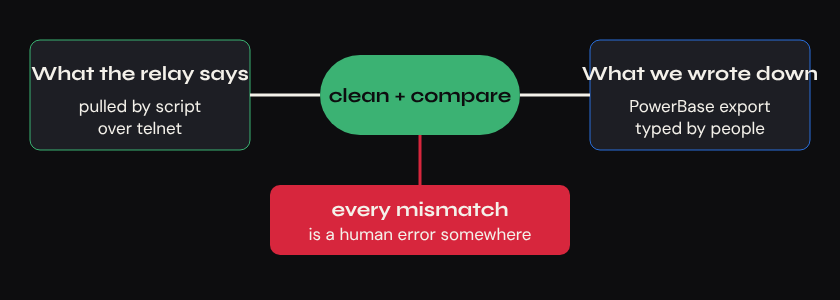
What the comparison found
The device dumps weren't ready to compare as they came. Formats differed, spacing differed, labels differed. That is where the twenty dollar tool earned its keep. A few passes of find and replace turned thousands of messy files into something lined up with the PowerBase export, and then the difference just fell out.
And there was so much of it. Serial numbers off by a character. Fields swapped. Values that had been copied from the wrong device. None of it was malicious. It was what happens when people hand type the same kind of information thousands of times. Humans are good at a lot of things. Retyping long strings perfectly forever isn't one of them.
The lesson
Compliance work sounds like big systems and expensive tools. A lot of it is actually this: get the machine to tell you what it is, get the record of what you think it is, and compare them without trusting either one. The database was only as good as the last person who typed into it. The script was only as good as the last odd response it hit. Put them side by side and they check each other.
You don't need a big budget to do that. You need to be a little suspicious, and you need to know the cheap tool exists.
Inspired by Happy, written by Claude.
Next relatedStop Calling It FirmwareRevision history (R0 current)
| Rev | Date | What changed | Page |
|---|---|---|---|
| R0 | Nov 17, 2026 | First published. | view |